





FOR BIOMEDICAL RESEARCHERS

Reviewer-grade scrutiny foryour biomedical manuscript.

Thesify reviews life-science manuscripts the way a journal reviewer does — study design and power, statistical reporting, reporting-guideline alignment, ethics and data availability. Catch what triggers a desk rejection before an editor does.

Biomedical manuscript review illustration

Trusted by more than 30,000 academics at leading universities

EPFLHarvardOxfordETH ZurichUCLCambridge

IN SHORT

What does an AI reviewer check in a biomedical manuscript?

It checks the things biomedical reviewers raise first: whether your design and sample size support your conclusions, whether statistical reporting is complete, whether the manuscript follows the reporting guideline for your study type, and whether ethics, consent and data availability statements are in place.

Minutes
To a full manuscript report
Methods first
Design, power and statistics reviewed in depth
200M+
Indexed articles behind every literature check

Desk rejection

The outcome for a large share of submissions to selective journals — decided before external review begins.

Reporting standards

CONSORT, PRISMA, ARRIVE and STROBE expectations, checked against your manuscript before you submit.

One cycle saved

Fixing methodological gaps now avoids a rejection-and-resubmit round measured in months.

Methods and statistics,read line by line.

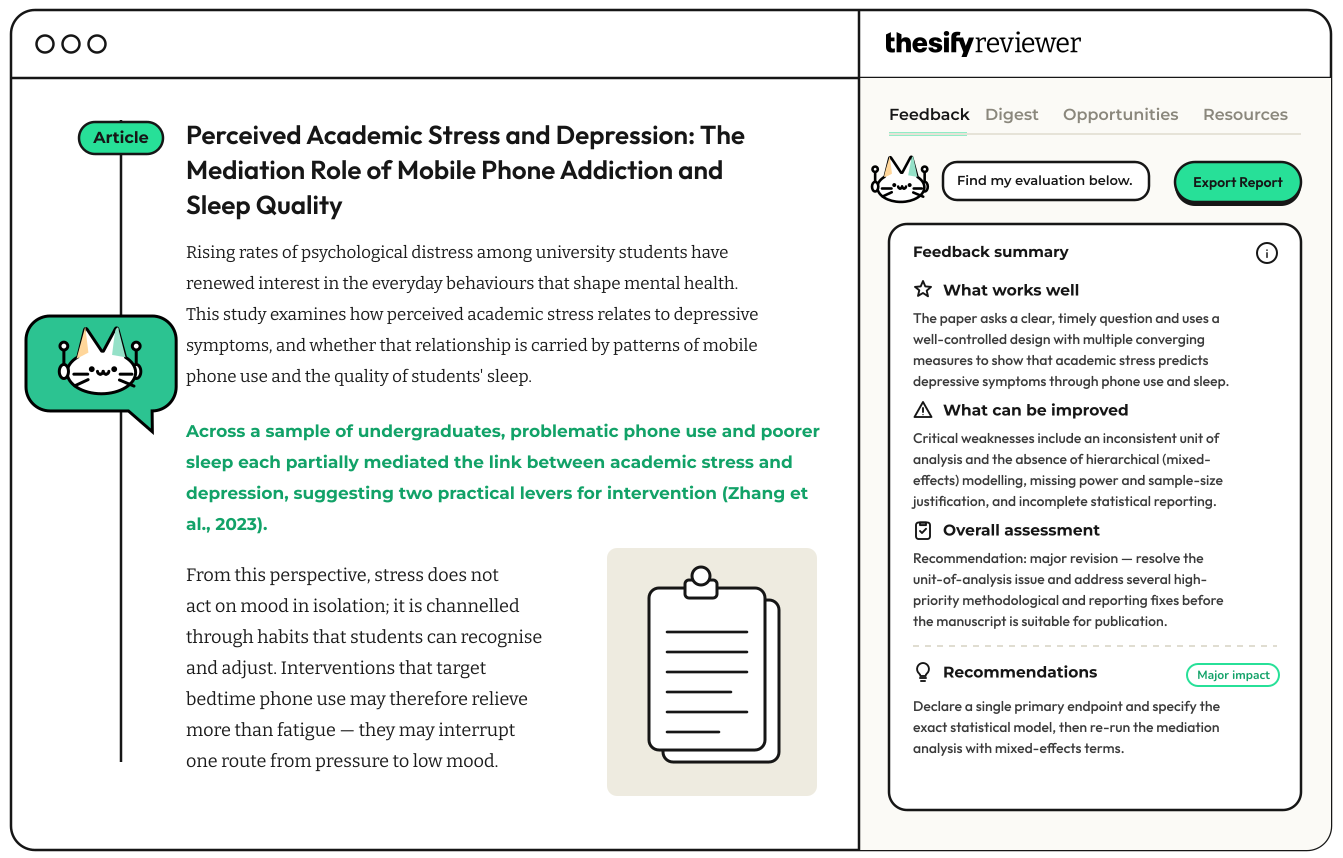
Thesify examines whether your sample size is justified, whether the analysis matches the design, whether effect sizes and uncertainty are reported, and whether your conclusions stay inside what the data support. Each issue is graded by severity with a specific, actionable fix.

Review My Manuscript
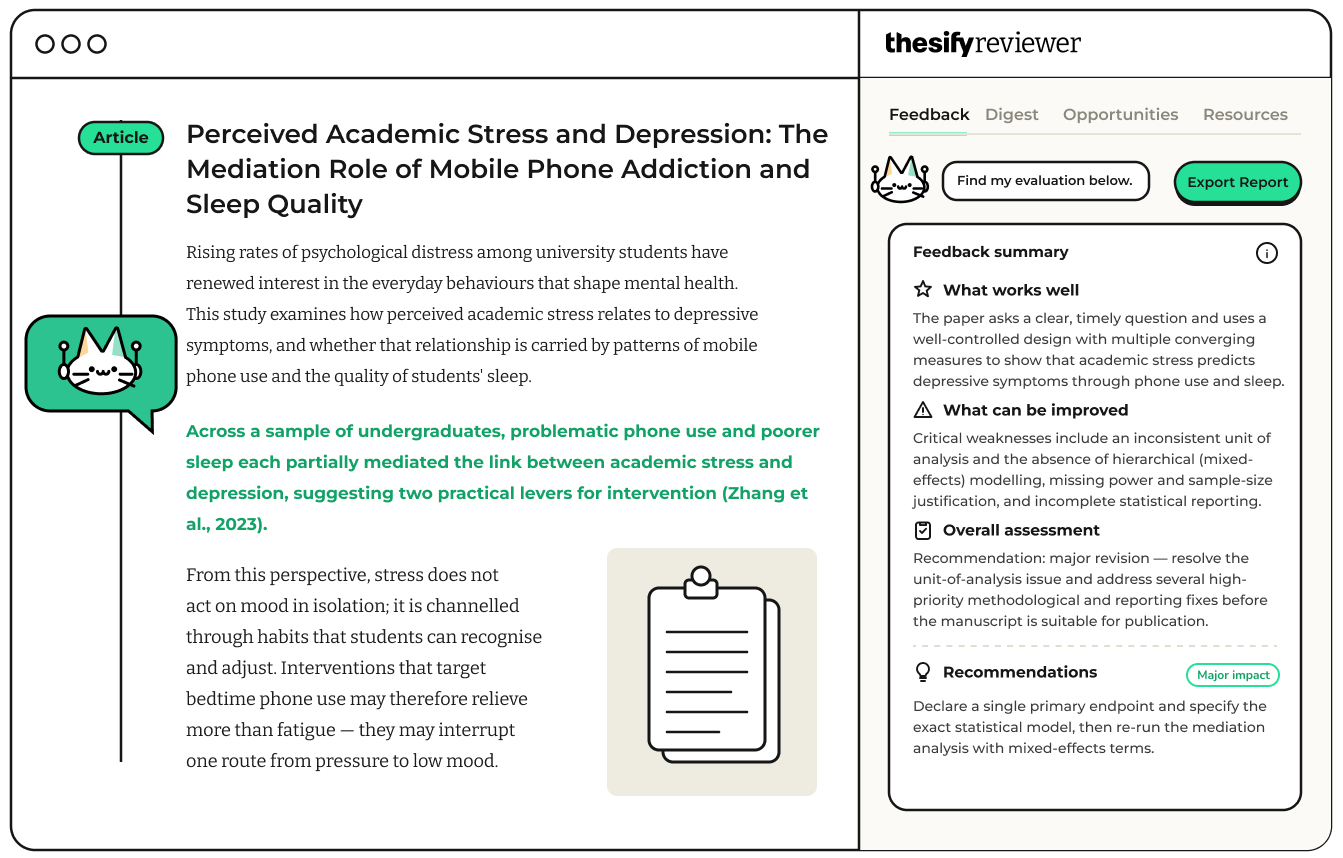
Methodological feedback on a biomedical manuscript

Choose the venuebefore you format for it.

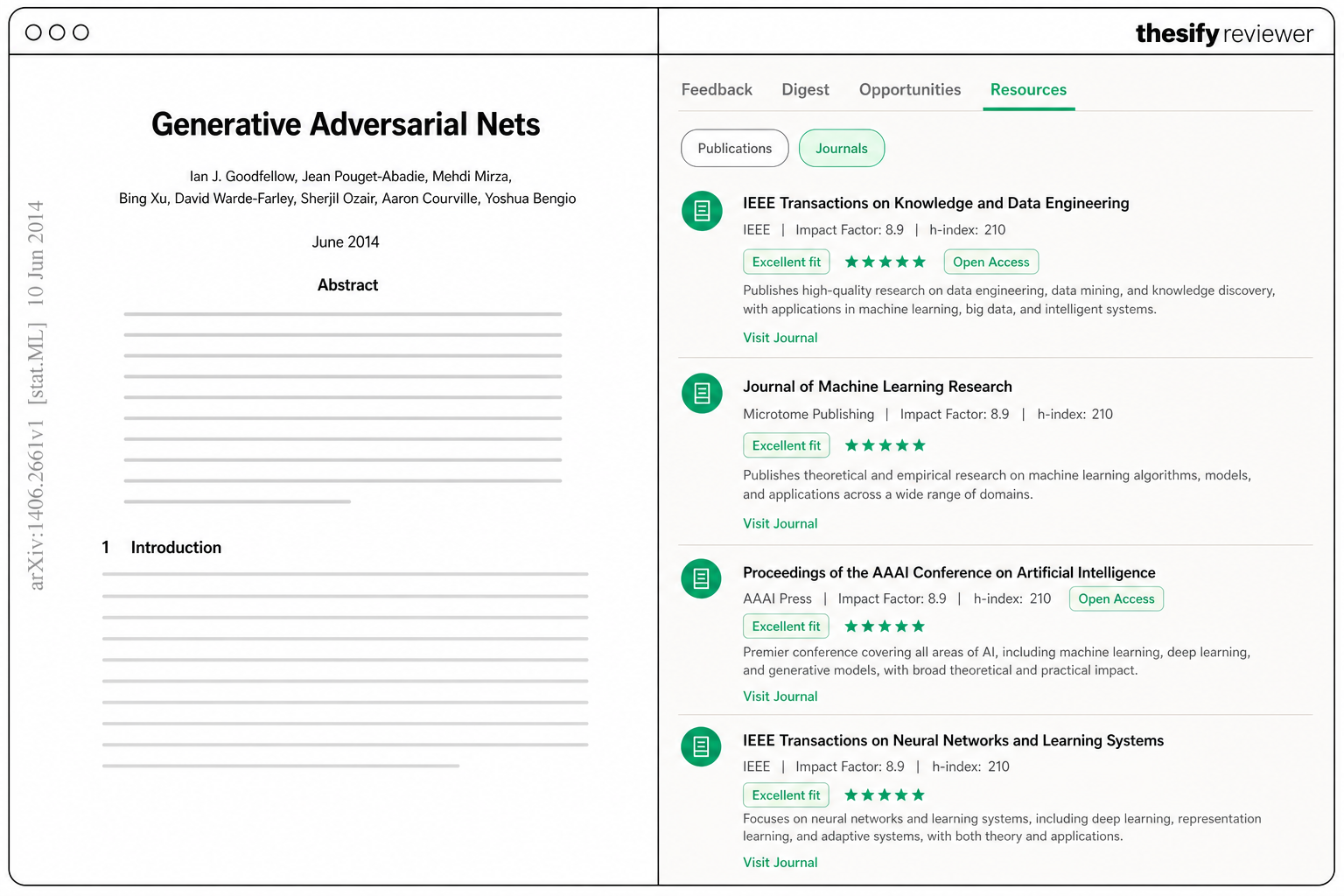
Compare candidate journals by semantic fit with your manuscript, not by prestige alone — with impact metrics and publication volumes side by side. Publisher-independent, so the ranking reflects your paper rather than someone’s catalogue.

Find My Journal
Journal matching results for a manuscript

WHAT IT CHECKS

The rigor questions a biomedical reviewer asks.

Field-specific review, not generic writing feedback — aimed at the methodological and reporting problems that decide biomedical submissions.

Study design & power

Is the design appropriate for the question, and is the sample size justified rather than assumed?

Reporting guideline alignment

Does the manuscript meet the expectations of the reporting standard for its study type?

Statistical reporting

Are tests, effect sizes, uncertainty and multiplicity handled and reported completely?

Ethics, consent & data availability

Are approval, consent, conflicts and data or code availability statements present and specific?

Figures, tables & legends

Do figures stand alone, and do legends give a reader enough to interpret them without the text?

Claims vs. evidence

Does the abstract promise more than the results deliver — the most common reason for a rewrite?

Why a general chatbot is not a reviewer.

Biomedical review depends on methodological judgement and real literature. Those are exactly the places general-purpose tools fail.

Feature
ChatGPT
Thesify Reviewer
Checks reporting-guideline alignment
NO
YES
Reviews statistical reporting against your claims
RISK
YES
Never fabricates references
RISK
YES
Grounded in 200M+ indexed articles
NO
YES
Your unpublished manuscript stays confidential
RISK
YES

A desk rejection costs you a submission cycle, not an afternoon.

Reformatting for the next journal, re-running an analysis a reviewer asked about, waiting out another editorial queue — the cost of a preventable rejection is measured in months of a project you have already finished. A pre-submission review is the cheapest round of revisions you will ever do.

Methods

Design, power and statistical reporting reviewed before an editor sees the paper

Guidelines

Reporting-standard expectations checked against the manuscript you are about to submit

Confidential

Unpublished work stays private — never shared, never used for AI training

Review My Manuscript

What researchers are saying

Andy Stapleton

Andy Stapleton

@DrAndyStapleton

It is the academic tool kit we have been waiting for. There's so many ways you could use this, but ultimately, for what it does - give you feedback, making sure you're meeting academic standards - it doesn't get much better at the moment.

Neha Agrawal

Neha Agrawal

@WiseUpCommunications

I was super impressed with the evaluation because it was able to pick up minute, yet important gaps in my research, which even a well-read professor would have missed out. With this kind of in-depth feedback, you can be quite sure that your work is going to meet the requirements of your supervisor and peer-review process of journals.

Amina Yonis

Amina Yonis

@DrAminaYonis

It's a beautiful tool because it not only enhances your writing but also increases your confidence by maintaining your unique tone while explaining the rationale behind each improvement.

As seen in

NatureForbesUSA Today20 MinutenBerner Zeitung

SUBMITTING TO A JOURNAL?

Get matched to journals ranked by fit, not prestige.

Our Journal Submission track adds journal matching and reviewer-style feedback built specifically for manuscripts headed out the door.

Explore Journal Submission
Manuscript matched to journals illustration

Frequentlyasked questions.

Does Thesify understand my subfield? +

Thesify reviews the parts of a manuscript that transfer across biomedical research: design, power, statistical reporting, guideline alignment, ethics statements, figures and the fit between claims and evidence. It is not a substitute for a specialist collaborator on subfield-specific interpretation, and it will not tell you whether your hypothesis is biologically plausible.

Which reporting guidelines does it know? +

Feedback is framed around the widely used reporting standards — CONSORT for trials, PRISMA for systematic reviews, ARRIVE for animal research, STROBE for observational studies. You should still complete the official checklist your target journal requires; Thesify helps you find the gaps before you do.

Can I upload a manuscript with patient data? +

Please de-identify before uploading. Thesify is designed to review manuscripts, not to process identifiable patient data, and manuscripts submitted for publication should already be de-identified. Uploads are encrypted, never shared and never used for AI training.

Will using it affect my preprint or submission? +

No. Thesify gives you feedback on your own draft and produces no text for the manuscript, so there is nothing to disclose to a publisher beyond what your target journal asks about writing assistance. Your work is not published, indexed or shared by us.

How is this different from paid editing services? +

Language editing fixes how the manuscript reads. Thesify addresses why manuscripts get rejected: design and reporting gaps, claims outrunning evidence, and missing methodological justification. It returns a structured report in minutes rather than days, and costs a fraction of a per-manuscript editing fee.

Does it help me pick a journal? +

Yes. Journal Finder ranks candidate venues by semantic fit with your manuscript alongside impact metrics and publication volumes, and it is publisher-independent — so the shortlist reflects your paper rather than a publisher’s portfolio.

academic integrity.

Rigor first. Your manuscript stays confidential.

Review My Manuscript